Cost of Marine GPS Tracking Hardware for Boats
Before we look at the actual cost of hardware, a quick explanation on how our systems actually work. In orbit around the Earth are a number of satellites that make up the 'Global Positioning System' or GPS. If you have a receiver in a vessel and it can locate at least 3 of them, it can work out where it is. This is done by a process called trilateration: put simply, your receiver calculates how far it is from a satellite and draws a circle where it thinks it is. It now repeats that at least twice, and where those circles overlap is its location.
So now it knows where it is, it needs to tell our server so we can place it on the map. It does this using GPRS (Radio Data) and the Internet. A data transmission unit is housed in the same box as the receiver, and at set times it takes the location from the GPS receiver and transmits it to any nearby cellular network's mast. This then relays it via the Internet to a computer server which can be anywhere in the world. To achieve this in such a small package, our trackers have extremely sensitive aerials so they can be included inside the unit, avoiding tell-tale external aerials.
Our 4G maritime vessel GPS tracker range
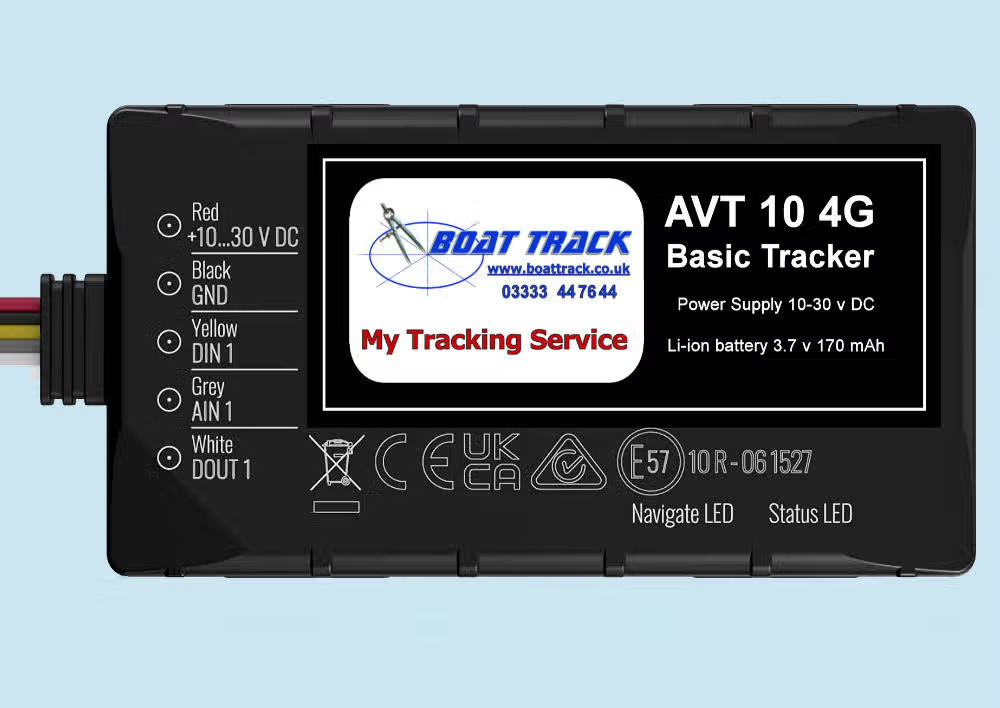
AVT10 4g Budget Internal Tracker
The 4G AVT10, it is true to say, is built to a price. It does not have as many inputs as its bigger brothers, but importantly, being 2G, 3G, and 4G operational, this unit will work all over the Mediterranean, down the coast of France and Spain, as well as here in the UK.
If you are a weekend sailor using it largely to just check your vessel's location and store its history, or you are worried about unauthorised use of your vessel in your absence, then this could be the unit for you.
It can be mounted almost anywhere inside a wooden or GRP vessel's hull, inside a GRP flybridge, or just placed inside a RIB's GRP control/steering. Cost is just £55
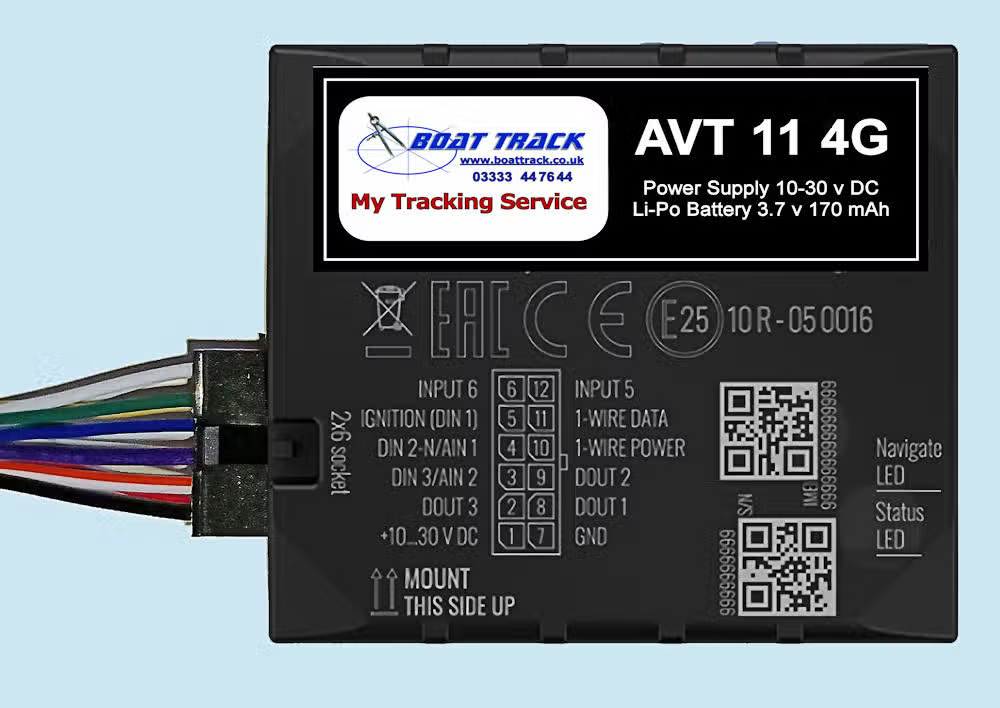
AVT11 4g Standard Tracker
Our best-selling standard tracker — this 4G unit ticks most boxes, and because the aerials are inside, it is very easy to install, just requiring to be mounted where it can electrically see the sky, i.e. label side up (for example under the deck, inside a locker, or under a fibreglass/wooden roof). It is splash-proof and also has an internal backup battery (lasts around 3 hours). Being a 4G unit, it will work both inside and outside UK waters.
If you operate commercially and your insurance requires you to install a tracker, as long as you don't need waterproofing, this one will work for you. It just needs a 10–30 volt supply, and if you are on our Standard monthly rate, it can send basic messages, such as when the engine is used, along with geo-fence updates. Cost £65
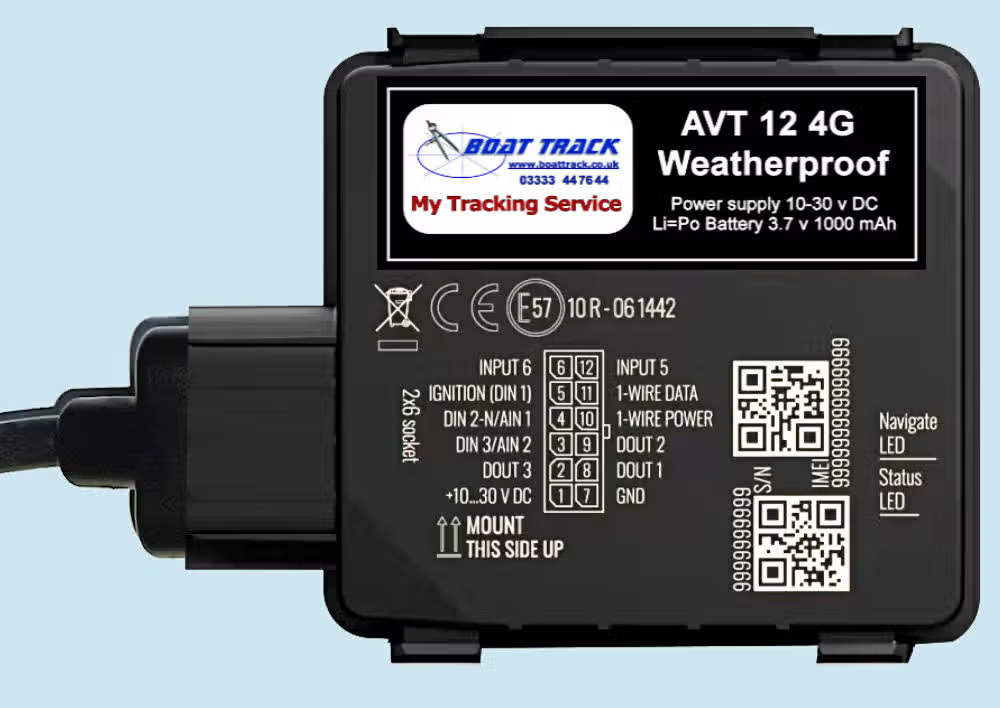
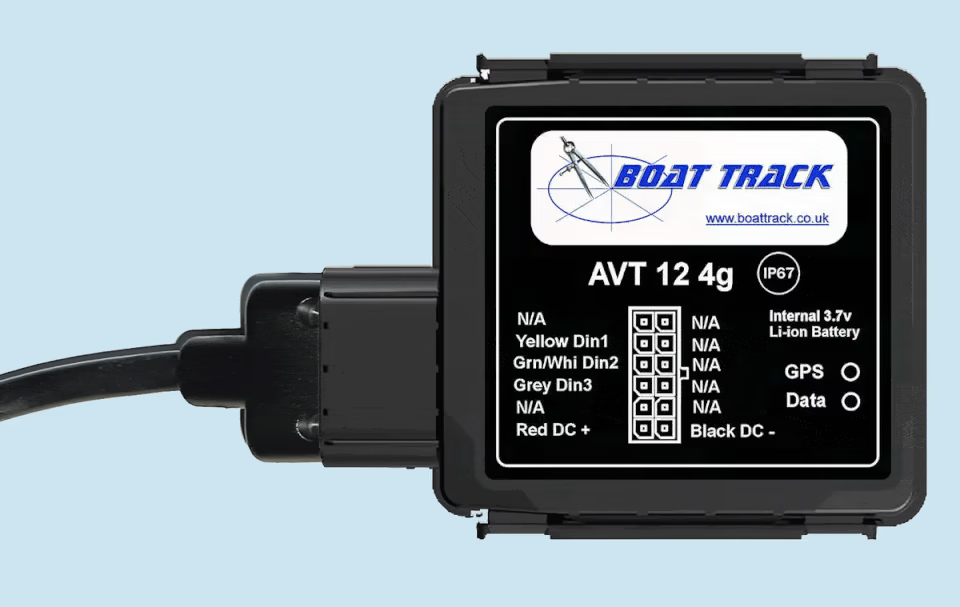
AVT12 4g Weatherproof
By far our best-selling all-round unit, this semi-pro tracker is an excellent choice for a wide range of vessels. With its rugged, weatherproof housing rated to IP67, it provides added protection where it matters most—especially for sports boats or any vessel where water ingress can easily occur. Please note: while the unit is designed to withstand challenging marine conditions, it should not be exposed to a direct hit from a high-pressure water jet when cleaning the vessel.
With 4G connectivity, the tracker is a future-proof solution that can be easily transferred to your next vessel, whatever that may be. It can be discreetly mounted on or beneath a fly-bridge, cabin roof, control console, under a RIB seat, or in other suitable on-board locations. Customers on our Standard monthly rate can also benefit from alerts when key equipment—such as the power anchor, engines, or trim—is used, along with useful geofence updates. For long-term convenience, the unit can even receive software updates over the air. Cost £75
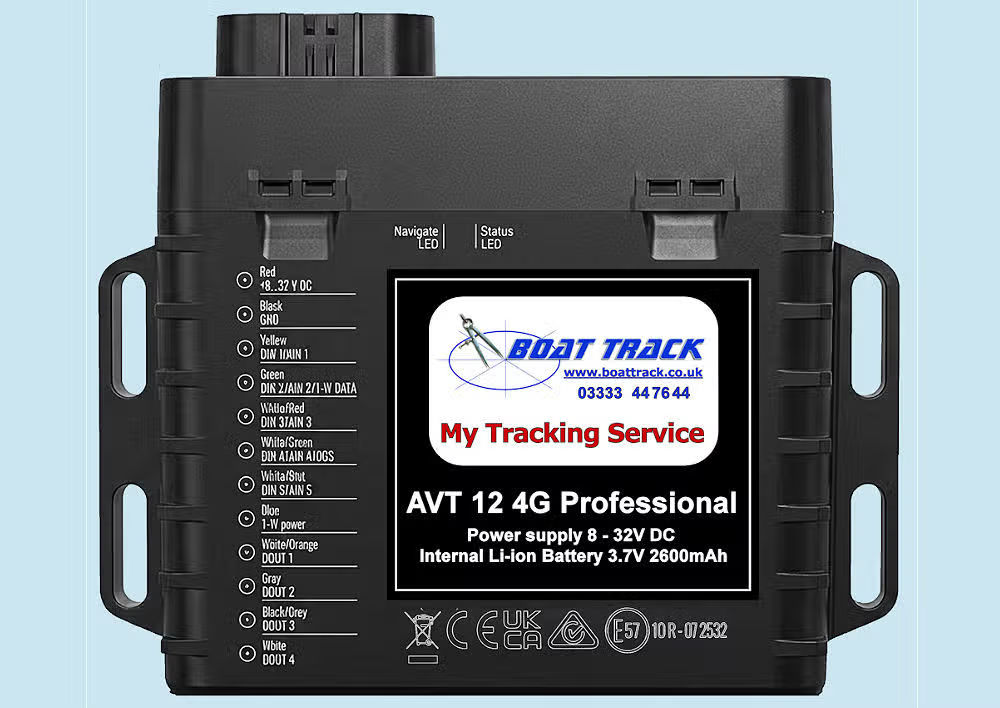
AVT12 4g Professional
New for 2026, this professional-grade tracker is built to deliver reliable, all-round vessel monitoring with outstanding resilience and performance. Rated to IP69K for exceptional weatherproofing, it is designed to withstand demanding marine environments. Its high-capacity 2,600 mAh battery, combined with a Power-Off sleep mode that reports a couple of times a day, can provide an impressive battery life of around three months when your vessel's power is off. Advanced sensors allow the unit to monitor and report to you up to three power supplies simultaneously, such as the main battery, utility battery, and shore power, while also detecting when selected on-board circuits are switched on.
For added convenience and control, the tracker can also be used to remotely switch vessel circuits on or off, including isolators or lights. With 4G connectivity, it is a future-proof solution that can easily transfer to your next vessel, whatever type of boat that may be. Over-the-air software updates help keep the unit current, capable, and ready for the years ahead. Cost £95
Battery operated GPS Trackers
If your vessel has no main battery, if it is on a trailer most of the time, or it just does not have the option of shore power, one of these units could be the answer! Our normal trackers, when in sleep mode, can last many, many weeks, but even they will eventually flatten your vessel's battery. These battery-powered units solve that problem in a different way: one has its own long-life, replaceable internal AA batteries, while the other has a built-in solar charger to top up its internal battery.
It is important to understand they work differently to the vessel-powered trackers above, because unlike those units, they do not react to what the host is doing in the same way! They will still give you more frequent updates when moving and less frequent when static, because clearly every update uses up battery power. The timing will depend on location and local cell site signal strength — for example, a vessel in the Mediterranean using the solar-powered unit will be able to have much more frequent updates than a vessel cruising Scottish waters. In most cases, an update every one or two hours when not moving, increasing to every 10 to 15 minutes when underway, is achievable without putting too big a load on the batteries. Because we are able to update our units over the air, if we get the setting too low or too high, we can adjust it without the need to send the unit back.
You can see more about sleep mode and a little more about the battery tracker in a short video here
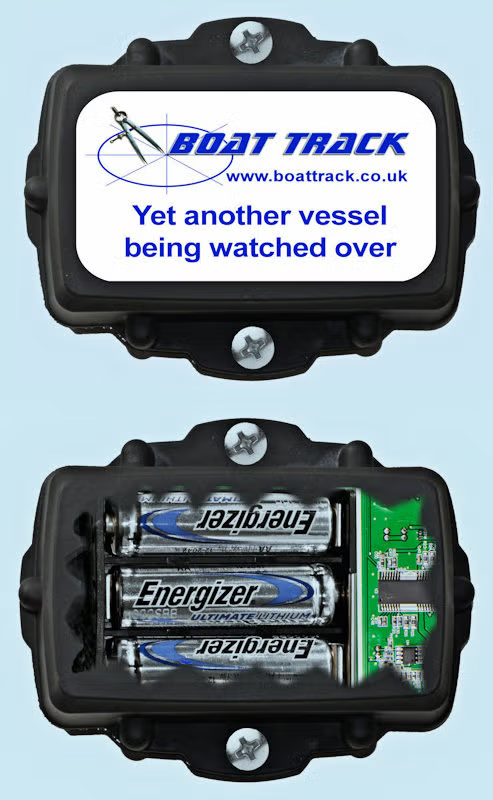
AVT21 4g Internal Battery Powered GPS Tracker
This 4G GPS tracker runs on its own internal lithium version of the standard AA battery. When the batteries do get too low to work, you can just replace them yourself with readily available replacements from places like Amazon for just a few pounds each. Working on LTE-M, or NB-IoT (where available, depending on location), it draws much less current in use than a traditional cellular tracker; unfortunately, that makes them more expensive to manufacture.
It costs £139, which is more than our other trackers, but for owners of trailer-mounted vessels or jet skis, they are still a very attractive and unique option.
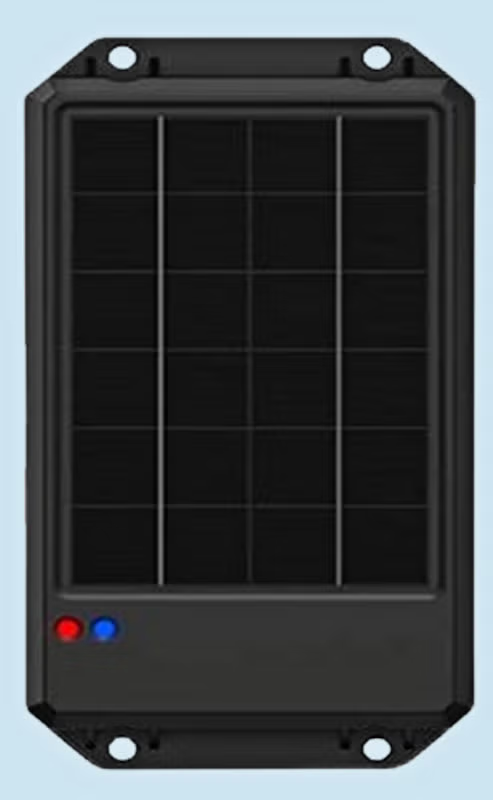
AVT22 4g Solar Powered GPS Tracker
This solar-powered GPS tracker uses the sun to keep it alive. The update rate can be programmed over the air, so those in sunnier locations like the Med can have slightly more frequent updates than those in the UK. It's not for anyone wanting a detailed history, but it's perfect for those on a swinging mooring who just want to know it's still there — or if you're concerned someone is moving your vessel while you're away, this could be a solution.
It costs £95, and being weatherproof and self-contained, it can easily be fitted on top of locations like flybridges or under a cabin skylight, etc., as long as it can see the sun.
While talking solar power, if you are happy to fit a basic 30–50 watt solar panel (around £35 on Amazon), some customers have found that the AVT12's, with all the advantages they have of ship monitoring etc , will work just as well if set to sleep mode when not moving, then they give the same more frequent updates it does in a vessel with a battery when underway. This is because the AVT12's own internal battery only needs a trickle charge to keep it awake, although, of course, that assumes you are a weekend sailor and are not using the vessel seven days a week.
Some Questions you may have
Why do I need 4G? There can be no doubt that the days of the existing 2G and 3G data networks in the UK are numbered! Already, around the world, some 3G sites were closed early in 2022/3, and by the end of 2026 they will probably all be gone from most of Europe. Of course, in the UK we also know that because of the huge amount of infrastructure using 2G (power company smart meters, M2M applications like vending machines, etc.) that will have to be replaced, it is likely to be a few more years yet before the 2G networks that our first-generation trackers use are closed down (probably after 2026, with O2 and Vodafone recently suggesting it will be gone soon after 2030).
It's of more immediate concern in some parts of the world that are not as advanced, data-wise, in 2G terms, or where the population is thinly spread across the nation! Scrapping of the older networks has already started in places including Australia, New Zealand, parts of the USA, and some countries bordering the Mediterranean. Therefore, for our customers operating there and in other 'at risk' places, since 2023 we have been offering a future-proof version of our AVT10, AVT11, and AVT12. These 4G units will work as usual using the 2G- and 3G-based packet data networks, but they also use the latest LTE, or 4G, networks that are replacing them. In the event the unit cannot find the older networks, it will automatically switch to 4G and continue sending.
Theft Deterrent: Let us be clear — there is no device made, be it ours or any other company's, that can stop someone stealing your boat, and any salesman who tries to tell you different is a liar! That said, a well-hidden installation and some common sense can help a lot. Your first line of defence is that, if it is stolen and you are checking regularly, you will know about it well before you turn up at the marina with the family for a day out.
If you are on our standard rate and have an anti-theft device already installed, you can run a feed from the siren to our unit, and it will send you a message when it goes off. A micro or magnetic switch on a cabin door, or even a simple, inexpensive under-carpet pressure pad, can do the same thing. A relay in your shore power feed will activate it when power is disconnected. The simple act of geo-fencing your mooring will allow you to be emailed if it leaves the area, and there are many more options — just talk to us to find out what others have done.
About our hardware: As you can see, our units are not expensive, but you will sometimes find other devices (usually on online shopping sites) that are cheaper. They, just like us, use the American GPS system set up during the eighties; as a result, these largely Asian imports will work OK here. However, our systems also use the European GALILEO and Russian GLONASS GPS systems, making our systems considerably more accurate, as well as giving better coverage in difficult locations. Some of those systems do not have 'memory backup' to store fixes that have not been sent; ours can store days of information to send later. Many tracking systems don't react to your change of direction; ours will send a fix if you 'tack' more than a few degrees. Just a few of the many things we do to make our tracking systems suited to all types of mariners.
When we first started supplying trackers in the nineties, all trackers were made up of modules and had an outside aerial! Below is a picture of the first vehicle tracker we designed and had assembled in nearby Fareham, along with the trackers we supply today for comparison.
Our first tracker circa 1998 using Mobitex
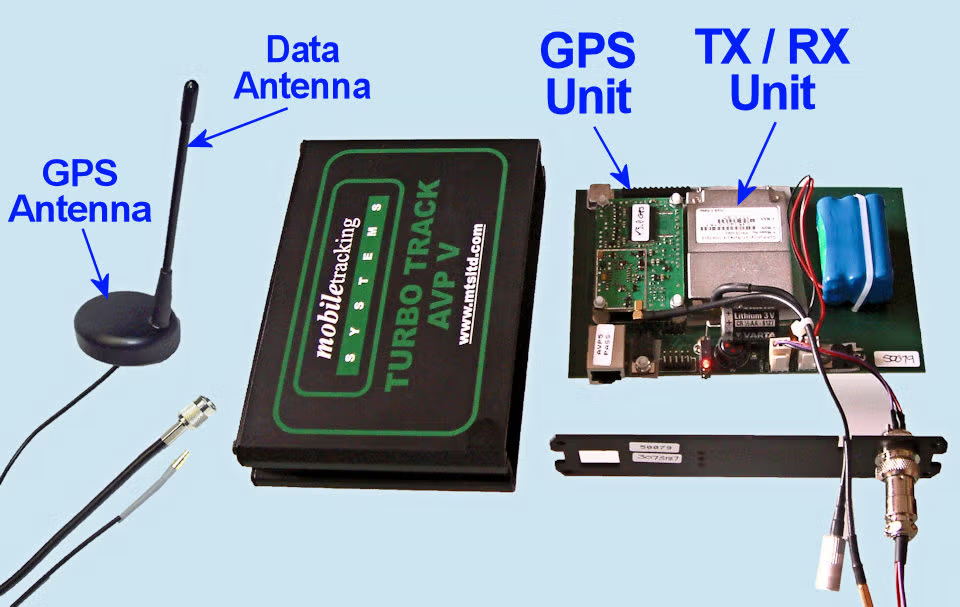
The Inside of a Modern GPS Tracker
At that time, most customers were companies who hosted the server themselves, but these days you don't have to have the hassle. Modern computer devices let you go and 'peep' at your data on a professionally hosted server, just using any internet browser. This means that wherever you are in the world, as long as you can borrow an internet device and know your password, you can check on your vessel anytime!
About Ordering: All of our tracking devices and accessories can simply and quickly be ordered by email, or by phone 03333 44 76 44, or if you are outside the UK, +44 3333 44 76 44. All goods are normally dispatched within 24 hrs, but if you need it the same day, call us and we will see what we can do. If you find the above selection bewildering and are not sure which one would be best for your needs, please phone us and let our experts guide you. You will not be greeted by a high-pressure sales-person, just a fellow sails-person!